
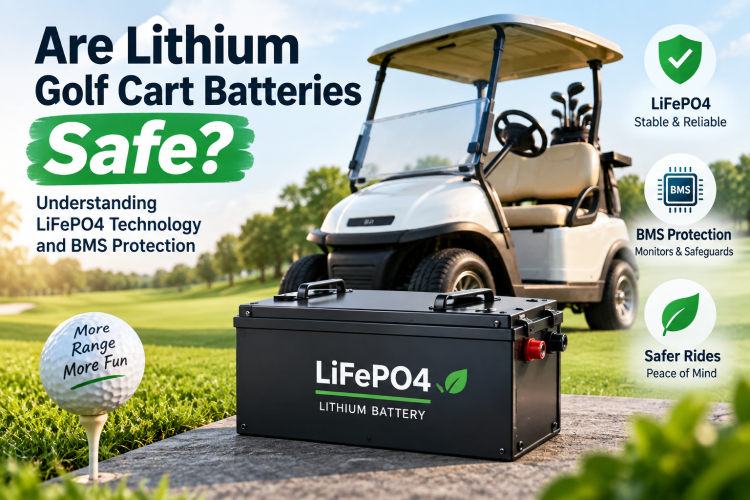
Yes, lithium golf cart batteries are generally safe when they use LiFePO4 chemistry, a quality Battery Management System (BMS), and proper installation. LiFePO4 batteries offer strong thermal stability, while the BMS monitors voltage, temperature, current, charging, and discharging to help prevent unsafe operating conditions.
Have you ever wondered whether putting a large lithium battery under your golf cart seat is really safe? 🔋 It is a reasonable question, especially when lithium battery fires sometimes make headlines. However, not all lithium batteries use the same chemistry or safety systems. LiFePO4 golf cart batteries are designed with stability and protection in mind. Understanding the battery chemistry and its BMS can help you make a smarter choice.
🔋 Are Lithium Golf Cart Batteries Really Safe?
Modern lithium golf cart batteries can be very safe when properly designed, installed, charged, and maintained. Many golf cart battery packs use lithium iron phosphate, commonly called LiFePO4 or LFP. This chemistry is known for good thermal and chemical stability. It also does not require the routine watering associated with flooded lead-acid batteries. Still, battery quality and correct installation matter.
A lithium battery should never be judged by chemistry alone. The cells, wiring, enclosure, charger, connectors, and electronic protection all work together. A well-designed Battery Management System adds another important safety layer. It continuously watches the battery while you drive or charge. ⚡ If operating conditions move outside preset limits, the BMS can take protective action.
| Safety Feature | LiFePO4 Battery | Flooded Lead-Acid Battery |
| Battery Management System | Usually included | Typically not included |
| Acid Spill Risk | No liquid acid | Possible |
| Routine Watering | Not required | Required |
| Gas During Normal Use | No routine hydrogen venting | Hydrogen may be produced while charging |
| Thermal Stability | High among common lithium chemistries | Different chemistry; not subject to lithium thermal runaway |
🧪 What Is LiFePO4 Battery Technology?
LiFePO4 stands for lithium iron phosphate. It is a type of lithium-ion chemistry that uses lithium iron phosphate as the cathode material. It has become popular in golf carts, RVs, marine systems, solar storage, and other deep-cycle applications. One reason is its balance of safety, cycle life, and usable energy. It can also deliver steady power throughout much of its discharge cycle.
LiFePO4 chemistry has a strong phosphate-based structure. This contributes to its thermal stability compared with some other lithium-ion chemistries. That does not mean an LFP battery is impossible to damage or misuse. Severe physical damage, incorrect charging, poor manufacturing, or electrical faults can still create hazards. Safe chemistry works best when paired with good engineering.
🛡️ How Does A BMS Protect A Golf Cart Battery?
Think of the Battery Management System as the battery pack’s electronic safety controller. It tracks key operating conditions across the battery pack. Depending on the design, it may monitor individual cell voltages, pack current, and temperatures. It can also control charging and discharging when limits are exceeded. This happens automatically without requiring constant attention from the driver.
A capable golf cart battery BMS may provide protection against:
- Overcharging when voltage rises beyond safe limits
- Over-discharging when cell voltage becomes too low
- Overcurrent caused by excessive electrical demand
- Short circuits under defined fault conditions
- High temperatures during charging or discharging
- Low-temperature charging when supported by the BMS
The exact protection thresholds vary by battery design. That is why matching the battery, BMS, charger, controller, and motor requirements is important.
⚡ How Does Overcharge Protection Work?
Lithium batteries need controlled charging. A compatible charger supplies the correct voltage and charging profile for the battery pack. Meanwhile, the BMS watches cell and pack conditions throughout the charging process. If a monitored value reaches its programmed protection threshold, the system can limit or disconnect charging. This helps protect cells from operating beyond their intended range.
However, a BMS should not be treated as a reason to use the wrong charger. Always use a charger approved or specified for your lithium golf cart battery. A charger intended for another battery chemistry may use an unsuitable charging profile. The battery manufacturer should provide compatible charging specifications. Following those specifications improves both safety and battery performance.
| BMS Protection | What It Monitors | Why It Matters |
| Overvoltage | Cell/pack voltage | Helps prevent excessive charging |
| Undervoltage | Cell voltage | Protects against deep discharge |
| Overcurrent | Electrical current | Helps protect cells and components |
| Temperature | Battery temperature | Limits operation outside set ranges |
| Short Circuit | Sudden abnormal current | Can disconnect the pack |
| Cell Balancing | Individual cell voltage | Helps maintain balanced cell operation |
🌡️ Can LiFePO4 Golf Cart Batteries Catch Fire?
Any high-energy battery can present risks under severe abuse or failure conditions. However, LiFePO4 is generally considered one of the more thermally stable lithium-ion battery chemistries. Its chemistry is less prone to thermal runaway than several common nickel- and cobalt-based lithium-ion chemistries. This is one reason LFP is widely used for energy-storage and deep-cycle applications. Still, “safer” should not be confused with “risk-free.”
Physical damage, internal defects, electrical shorts, extreme heat, improper installation, or incompatible charging can create dangerous situations. Avoid using a battery with a cracked enclosure, damaged terminals, swelling, unusual odors, or unexplained overheating. Keep conductive tools away from exposed terminals. If a battery has suffered a major impact, follow the manufacturer’s inspection and replacement guidance.
🚨 What Happens If The Battery Gets Too Hot?
Temperature monitoring is an important feature in many quality BMS designs. Sensors can track temperature at selected points inside the battery pack. If temperatures move beyond programmed limits, the BMS may reduce or stop charging or discharging. This can help prevent additional heat from building inside the system. The specific behavior depends on the battery’s design.
Environmental conditions also matter. Avoid installing batteries where airflow or clearances violate the manufacturer’s instructions. Never cover a battery in a way that traps excessive heat unless the enclosure was designed for that purpose. ☀️ Likewise, check the specified operating temperature range before using a cart in extreme weather. Good installation practices complement the electronic protections built into the pack.
🔌 Why The Correct Lithium Battery Charger Matters
Your charger and battery need to work as a system. A lithium-compatible charger should match the voltage and charging requirements specified by the battery manufacturer. For example, a battery sold as a 48-volt golf cart pack may have charging requirements that differ from a 48-volt lead-acid bank. Choosing a charger based only on the nominal voltage can therefore be a mistake. Check the full charging specification first.
Some lithium batteries can communicate with compatible chargers or vehicle systems. Others rely mainly on preset charger parameters and BMS protection. Either approach can work when properly engineered. What matters is compatibility with your specific battery. Avoid improvised charging setups unless they are explicitly approved for the pack.
🆚 Are Lithium Batteries Safer Than Lead-Acid Batteries?
Lithium and lead-acid batteries have different risk profiles. Flooded lead-acid batteries contain corrosive sulfuric acid and can produce hydrogen during charging. They also require ventilation, terminal care, and periodic water checks. LiFePO4 batteries avoid liquid acid and routine watering. However, they require electronic management and compatible charging equipment.
| Consideration | LiFePO4 | Flooded Lead-Acid |
| Liquid Acid | No | Yes |
| Routine Watering | No | Yes |
| BMS Protection | Common | Typically absent |
| Hydrogen During Charging | Not a normal charging byproduct | Can occur |
| Weight | Generally lighter | Generally heavier |
| Charger Compatibility | Lithium profile required | Lead-acid profile required |
| Maintenance | Usually low | Regular maintenance needed |
Neither battery type should be abused or installed incorrectly. The safest choice is a properly certified and engineered battery system that matches your golf cart.
🏌️ What Should You Check Before Buying?
Do not shop by capacity and price alone. Start by checking whether the battery uses LiFePO4 chemistry and includes an integrated BMS. Then compare its continuous and peak discharge-current ratings with your golf cart’s demands. Check voltage, dimensions, terminal arrangement, charger requirements, and installation instructions. A battery that cannot support your cart’s peak current may trigger BMS shutdowns.
You should also look for clearly documented safety testing or certification claims that apply to the specific product. Verify those claims through manufacturer documentation rather than relying only on marketplace descriptions. A meaningful warranty and accessible technical support can also be valuable. Finally, confirm compatibility with your cart model and any upgraded motor or controller. 🔍 This is especially important for modified high-performance carts.
🔧 How To Install Lithium Golf Cart Batteries Safely
A lithium conversion should begin with compatibility. Confirm the required system voltage, battery current capability, physical mounting, cable size, and charging system. Secure the battery so it cannot shift while the cart is moving. Protect terminals from accidental contact with metal objects. Follow specified torque values for electrical connections when the manufacturer provides them.
For a conversion from lead-acid to lithium, check whether other equipment needs to change. The charger is a common example, but onboard accessories and voltage reducers may also require attention. Avoid altering BMS wiring or bypassing protection circuits. If you are uncertain about high-current wiring, use a qualified golf cart technician. Correct installation is part of battery safety, not an optional extra.
❄️ Are Lithium Golf Cart Batteries Safe In Cold Weather?
LiFePO4 batteries can generally discharge in cold conditions within their specified temperature range. Charging at very low temperatures requires more care. Charging LiFePO4 cells below their permitted temperature can cause lithium plating and permanent cell damage. For that reason, some BMS units include low-temperature charging protection. They can stop charging when the cells are too cold.
Some premium battery packs also include internal heaters. These systems can warm cells before charging begins in freezing conditions. If you live in a cold U.S. climate, check both the charging and discharging temperature specifications. Do not assume every lithium golf cart battery has cold-weather protection. ❄️ Look for that feature explicitly before buying.
🔄 How Can You Keep A Lithium Battery Safe?
LiFePO4 batteries usually need less routine maintenance than flooded lead-acid batteries. Still, a few simple habits can improve safety and reliability. Inspect cables, terminals, mounting hardware, and the battery enclosure periodically. Keep the pack clean and follow the manufacturer’s storage instructions. Never intentionally bypass a BMS protection event just to keep driving.
A simple safety routine includes:
- Use the specified lithium-compatible charger.
- Inspect cables and terminals for damage or looseness.
- Keep the battery securely mounted.
- Avoid physical impacts and water exposure beyond its rated protection.
- Follow the specified charging and storage temperature ranges.
- Stop using the battery if you notice swelling, smoke, unusual heat, or serious enclosure damage.
These steps are simple, but they address several common sources of battery problems. 👍
⏳ Does LiFePO4 Battery Age Affect Safety?
All batteries age. Over time, their available capacity and performance can decline because of normal chemical changes and usage. Temperature, charging habits, depth of discharge, and cell quality can influence the rate of aging. A quality BMS continues to provide its designed monitoring and protection as the pack operates. However, it cannot repair a physically damaged or severely degraded cell.
Watch for meaningful changes in battery behavior. A sudden loss of range, repeated BMS shutdowns, unusual heating, swelling, or charging problems deserve investigation. Do not open a sealed battery pack to diagnose cells yourself. Internal components can carry dangerous electrical energy even when the cart is switched off. Contact the manufacturer or a qualified service provider instead.
✅ Conclusion: Are Lithium Golf Cart Batteries Safe?
LiFePO4 golf cart batteries can provide a strong combination of safety, performance, and low maintenance when they are properly designed and used. Their thermally stable chemistry is a major advantage. An integrated BMS adds protection by monitoring voltage, current, temperature, and other operating conditions. Proper charging and installation remain essential.
When choosing a battery, focus on more than advertised range or amp-hours. Check its chemistry, BMS features, current ratings, charger requirements, testing documentation, warranty, and cart compatibility. Follow the manufacturer’s installation and operating instructions after purchase. 🔋 With these safeguards in place, LiFePO4 technology is well suited to modern golf cart applications.
❓ Frequently Asked Questions
Are LiFePO4 Golf Cart Batteries Safe?
Yes, quality LiFePO4 golf cart batteries are designed with strong thermal stability. Most reputable packs also include a BMS for added electrical protection. Correct installation and charging are still essential.
Can A Golf Cart Lithium Battery Catch Fire?
It is possible for high-energy batteries to fail under extreme abuse, damage, or electrical faults. LiFePO4 chemistry has better thermal stability than several other common lithium-ion chemistries. A quality BMS and proper installation further reduce operating risks.
What Does A Golf Cart Battery BMS Do?
A BMS monitors important battery conditions such as voltage, current, and temperature. It can disconnect charging or discharging when programmed safety limits are exceeded. Some systems also balance individual cells.
Can I Use My Old Lead-Acid Charger?
Do not assume an existing charger is compatible. Its charging profile may not meet the requirements of your new LiFePO4 battery. Use a charger specifically approved or recommended for your battery pack.
Is LiFePO4 Safe In Hot Weather?
LiFePO4 has strong thermal stability, but every battery has an approved operating temperature range. A BMS may shut down the pack if temperatures become excessive. Always follow the battery manufacturer’s temperature and installation limits.